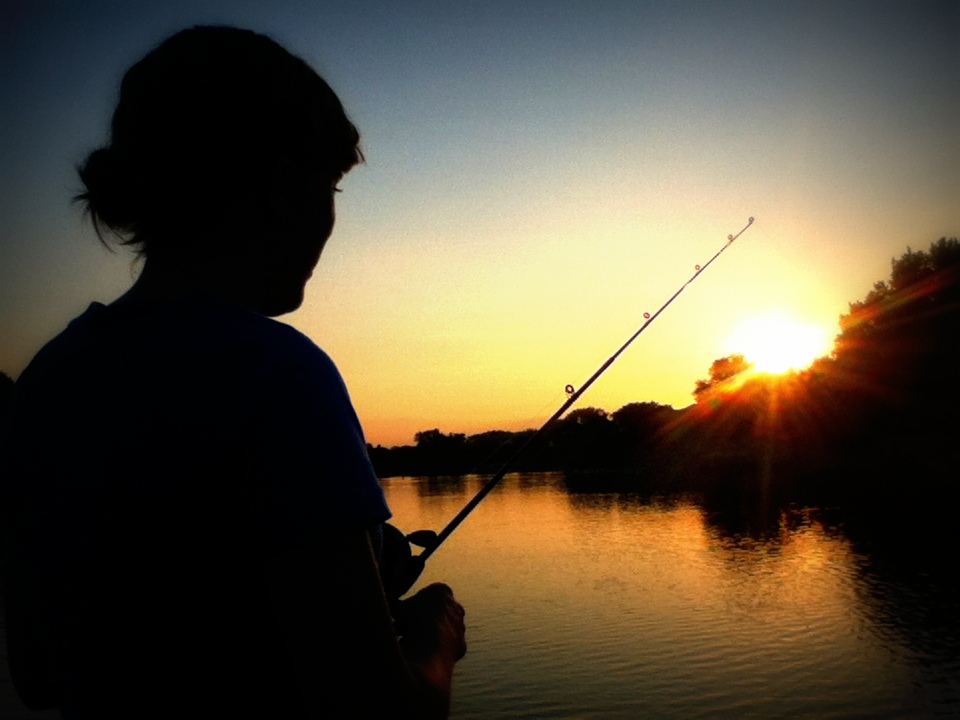
“Did you catch one?” asked 4 year old Cameron as I reeled in my lure from the front of my grandpa’s pontoon boat.
“No, not yet. But I’ve already caught five keepers, Cam,” I replied.
I’d caught 6 fish in less than an hour—and I was not the only one catching anything—yet still Cameron wanted to see more fish catching, more action, more entertainment.
Children often ask for more. You give one a cookie and she immediately wants another one, before she’s finished chewing the first. You throw a kid in the air to hear him tickled with glee, and then the first thing he says is, “Do it again!” …and again, and again. I may have more discipline now when it comes to asking for cookies or patience in fishing, but I’m still guilty of a childish desire for the next thrill.
Sitting with my back against our dwindling campfire later that night, I told my cousin, “I want to see another shooting star.” We had just seen a meteor zip across the sky and explode in the earth’s atmosphere, but I wanted to see another. My verbalized wish was almost immediately granted with a quick flash across the night sky. Then I caught my next thought: it was “More!”
As adults we may have more years than children, but we often operate on the same principles—only with more tact. We’re better at covering up our selfish desires and more subtle about our need for thrills.
Driving up to Nebraska this week I had 10 hours alone in the car to reflect on my summer in Central America. I rejoiced in all the beautiful moments and sights and relationships, but I also had the same, old doubts resurface. Where is this God I’m trying to follow? Why don’t I feel him? Here I’ve just had a refreshing summer full of examples of God’s faithfulness in my life, but still I ask where he is.
The key is remembering.
The Bible talks often of remembering what God has done for us. Old Testament rituals and celebrations emphasized re-living miraculous works of God. Yet the Israelites still forgot God as quickly as he blessed them. Communion/The Lord’s Supper is a sacrament to remember what Christ has done for us, yet we still turn back to sin. I have to keep choosing to turn to God and remember what he has done for me.
The morning of fishing and stargazing, I read Psalm 23. The psalmist says the shepherd “makes me lie down in green pastures,” “leads me beside still waters” and “restores my soul.” Here I was sitting next to my Grandpa’s green lawn and the glossy, still lake with a peace of soul. The last time I read the chapter I was in a bus headed into San Salvador. I’d read “Even though I walk through the valley of the shadow of death, I will fear no evil for you are with me.” Little did I know I’d end up staying in a dangerous part of town that night, but I was kept safe. It’s important for me to continually remember what God has done in my life. With my child’s memory I quickly forget the small blessings and miracles in my life.
We need habits of returning our minds to God’s wondrous works, and often the best way is reading the Bible. Lord, help us remember what you’ve done for us.
For my last full day in Central America, I decided to hike Volcán Atitlán, the highest of three enormous volcanoes rising high above Lake Atitlán in Guatemala. Peaking at 11,600 feet in elevation, Atitlán towers 6,500’ up from the water with a steep grade for hiking Being a difficult hike isn’t the reason why so few people hike Atitlán; stories tell it is too dangerous because of people. They say that trekkers are extremely likely to get held up at gunpoint or knifepoint, that the gangs or thieves steal your stuff and take your shoes so you can’t chase them. Well, I was up for it. I’m adventurous, daring, in shape from a month hiking in Costa Rica. I just planned to get robbed and was practicing in my head how to explain in Spanish that I only have water, food and Bible verses (while trying to hide the iPod touch).I set out after breakfast, excited for the day. I treaded quietly once I hit the trial, slightly paranoid about the stories (well, possibly more than slightly). I pushed up the mountain with a vigorous stride. I had a lot of ground to cover, a lot of work to do, to get to the top. Guatemalans working on the volcano also don’t seem to need switchbacks, so the trail was quite steep, feeding my ability to be an achiever in this hike.
After an hour and a half of strenuous climbing I had a spectacular view of distant Volcán De Fuego and Acatenango beyond the wide plains and other mountain ridges, and the conical peak of Volcán Atitlán loomed above. The beauty stopped my quick pace to stare out at the scene and let the valley’s breeze cool my perspiration. I’ve seen a lot of beauty this summer, and on the eve of leaving Guatemala I’m glad to reflect back on it and enjoy some more.The volcanic rock trail was well used through the landscape, but not like recreational trails in National Parks. Coffee farmers, corn growers, woodcutters and lumber jacks use these trails, and there is a whole network of paths working their way up the mountain.
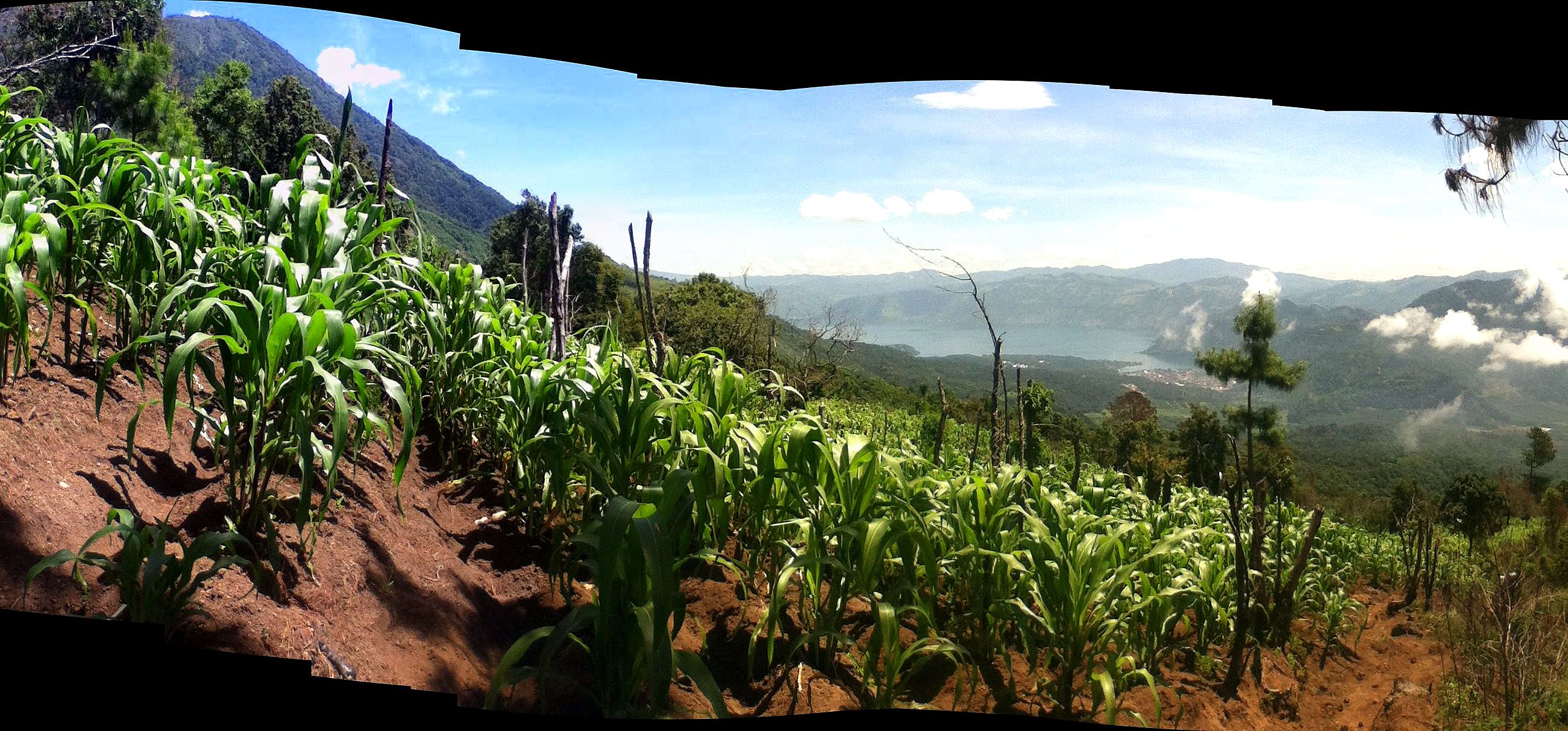
Blazing my way past coffee, corn and avocados, I rose above the clouds. I wondered why the hiking trail was going through corn fields as I pushed the large, green leaves to the side. Chance would have it that I’d gone the wrong way. I got to the top of the highest field. I was only about 1,000 or 1,500 feet from the peak of this volcano, but I could not continue any further with no path through the thick brush and cloud forest.
Oops.Then in the tall corn stalks I saw Francisco, working at 10,000+ feet—a two-hour uphill commute from his home. The hard-working Guatemalan explained to me in Spanish that I’d taken the wrong way up, and the trail for the peak was a quarter of the way around the volcano. I understood enough to know that it was a very long way back and I’d made a grave error in coming up this way.Running back down the trail I’d worked so hard to come up, I couldn’t help but be frustrated at myself for taking the wrong route. If only I’d gone the right way the first time. “Regresa” echoed in my head from Francisco’s instructions. You have to regress—to go back. If only I’d gone the right way the first time.It’s a lot easier to go the right way the first time instead of having to repent and go back.I was also frustrated that I probably wouldn’t be able to summit this volcano anymore. The setback from error was too critical to be able to make up enough ground before I’d need to head down before sunset and dinner. I kept hiking though, getting a fair bit further up the right path, and taking a few more wrong paths. I had to ask more Guatemalans for help. Some gave good guidance; some pointed me the wrong direction, making me appreciate the value of good advice. I had to call it a day before my legs got any weaker as I heard the thunderclouds drifting towards me. No mountaintop triumph today.
I hiked enough to have gotten to the top if I’d taken the right path. I would have made it in time. But after taking wrong trails, there was no way I could get to the top. I hiked all day for one of the biggest hikes of my life, but I didn’t make it. Sitting with the truth of my limitation is not easy. I want to achieve. I want to get there by myself.Once I turned around to run back down, a fresh wave of joy hit me as I felt peace in not needing to get to the top. The journey has been beautiful, and that is enough. What a reminder to rest in God’s grace! Here on the last day of my summer sabbatical God reminded me that He is enough for me—His grace is enough—and learning to rest in that truth brings joyous freedom.I ran down the mountainside in amazement as my eyes and feet thought quickly to hit the right rocks and avoid the dangerous roots. Being reminded that I’m good enough without achieving anything, I began to sing out the beautiful, old hymn, “Amazing Grace.”
Here are the words of the song with reflections on the themes of my summer:Amazing grace! How sweet the soundThat saved a wretch like me!I once was lost, but now am found,Was blind but now I see!Looking back on the past two months, I’ve been able to spend much time reflecting on the grace that is in my life. I meditated on God’s Word in the Jungle House. I memorized Ephesians 2:8-10 in three languages: English, Greek and Spanish. I experienced God’s blessing on my trip. Living in the city, it is easier for me to forget the grace I’ve been given, but away from the human-created urban world it’s harder to forget the God who made me. The more I think about grace, the more real it becomes… and the more I want to share it with others.T’was grace that taught my heart to fear,And grace my fears relieved.How precious did that grace appearThe hour I first believed.Even though I strive to fear God, I often fear man and strive to please them. Being in Central America provided me with time to remember God and to pray. I got away from big names, from big money, and from big things to do. I didn’t have to worry about my appearance, my clothing, my accomplishments. Grace is enough. Did I get to memorize scripture, study the Greek New Testament, and practice Spanish, according to my goals? Yes, but in freedom. I got experience freedom from the fear of man and relief from my normal busyness.Through many dangers, toils and snaresI have already come;‘Tis grace that brought me safe thus farAnd grace will lead me home.The hike was dangerous—I could’ve been robbed, broken an ankle, run out of water or been attacked by animals, but I wasn’t. God brought me through many dangerous circumstances this summer. Before leaving the US, I asked for prayers for health, for safety, and for protection from various temptations. God faithfully protected me from all kinds of sickness, disease, injury, crimes, and lusts. This is no small miracle for two months of traveling alone in Central America. Now I’ve been led home with habits of grace that I hope to continue until I reach my eternal home.When we’ve been there ten thousand yearsBright shining as the sunWe’ve no less days to sing God’s praiseThan when we’ve first begun.I spent the summer in some of the most beautiful places this world offers, in some of the most pleasant climates, with a most peaceful pace of life—but it wasn’t paradise. Life on this earth is still painful, lonely, uncomfortable, no matter where we go or how much money we have or spend. I look forward to a day when God reveals a new heaven and a new earth, and when the family of God comes together in glory.Thank you for all your prayers for me this summer. I have many people to thank for your support, advice, and encouragement. Above all, praise God for his grace in my life.
Adoption into the family of God is a beautiful thing, but how do we know who our relatives are? In my last blog post I wrote about finding Christian brothers and sisters during my time in Costa Rica. These heart-encouraging friends came as a refreshing contrast to those who didn’t believe as I do. But while these friends definitely felt like fellow adopted brothers and sisters, other acquaintances seemed like distant cousins. How do I know if they’re even in the body of Christ? Are they just odd family members or are they posers? Since we’re all adopted, it’s hard to tell who is in the family and who’s not (if anyone’s excluded…).
Now I need to say very clearly: I don’t claim to know who is in the family of God. I can’t know who’s in God’s family, because I’m not God; that’s why this post is difficult for me to write. Yet I do know what God has revealed to us about the adoption process and the signs for who’s in the fam.
Who’s in?
The Bible explains that through our sin and disobedience to God, humankind was separated from God. “God is light, and in him is no darkness at all,” says 1 John 1:5. God had to separate us from Himself once we took on the impurity of sin, and there is no way we can overcome the distance by ourselves. Because of our sin, the only possible result for a righteous God was punishment with death. “But because of his great love for us, God, who is rich in mercy, made us alive with Christ even while we were dead in transgressions—it is by grace you have been saved,” explains Ephesians 2:4-5, revealing the beautiful redemption we can receive through Jesus Christ who died for us. So how do we get adopted? “Through Jesus Christ,” says Ephesians, in accordance with God’s pleasure and will. God wants us to be his family, and we can be… if we accept the offer. Jesus already died in our place, but the Bible tells us we must also humbly turn from sin—having faith that being in God’s family is worth following Jesus. 1 John 1:9 explains that “if we confess our sins, God is faithful and just to forgive us our sins and to cleanse us from all unrighteousness.” The simple but monumental step is the good news offered to us called the Gospel. I write about it often, but only because I can tell no more important story.
Okay, so I get it… I believe that Jesus died for my sins and rose from the dead. Now what? How do you know I’m , that’s the tough part. We’ve all known way too many “Christians” who don’t act any different than anyone else. Yet the Apostle James says that “faith by itself, if it does not have works, is dead.” We’re supposed to be able to tell Christians apart because they obey the word of God—loving others, denying themselves, living generously. Jesus said,
Let me give you a new command: Love one another. In the same way I loved you, you love one another. This is how everyone will recognize that you are my disciples—when they see the love you have for each other.
Christians are supposed to be marked by love. Historically, we often have been—Christians stand up for human life even when it’s mangled, imperfect, old, deformed, or dangerous to do so. Christians give up comforts to serve the poor. Christians die for the message they believe.
Addressing Christian Universalism
Why are not all people in the family of God? Why isn’t everyone saved? These are some difficult questions I’ve come to wrestle with through interactions here in Guatemala. Christian Universalism holds that all people will ultimately be reconciled God without any eternal punishment for sin. The view is extremely appealing. Who wants to believe that people are going to hell? Doesn’t that make God seem unloving?
The questions are weighty; answers are not easy. Exclusivism is quite distasteful. Last week I sat in a metal school building discussing these ideas with a friend. As distant sunlight trickled in through the door across dusty concrete floors, we both felt the burden of differing theologies/beliefs about God and salvation.Looking to the Bible for truth, I’ve been studying Romans—a book I feel intimidated by for its dense theology. Romans 8 says, “There is therefore now no condemnation for those who are in Christ Jesus.” For those who are in Christ Jesus. In Christ Jesus. Everyone? No, it doesn’t seem so. Saint Paul writes that “Anyone who does not have the Spirit of Christ does not belong to him.” Hmm. He isn’t condemning anyone; instead, he is making clear that there is no condemnation for those adopted into the family of God through Christ.Paul is rejoicing in the grace given to those of us who believe. I still must soberly ask, what about the others? Will they not be saved? Why not? In the next chapter of Romans, Paul writes:What shall we say then? Is there injustice on God’s part? By no means! For he says to Moses, “I will have mercy on whom I will have mercy, and I will have compassion on whom I have compassion.” So then it depends not on human will or exertion, but on God, who has mercy.God chooses who will receive mercy? It seems unfair to my human way of thinking. I wish Paul wrote more about those who are not in Christ Jesus. Doesn’t the Bible also say that God “is the Savior of all people,” and “love never fails”? These are tough questions, yet I have to humbly hear Paul’s caution: “Who are you, O man, to answer back to God?” I’m limited in my thinking by my humanity. I don’t understand the ways of God; but if His Word says some receive mercy and some don’t, I have to stop questioning at some point and believe. I know belief in condemnation is not popular. I know it’s not “tolerant” of other religions and beliefs. I think I’d rather believe all will ultimately be saved, but the idea doesn’t sit well with me.I feel that universalism sucks the power out of the Gospel. If all will ultimately be saved, what’s the point in belief? What’s the point in following God in this life? Why all the talk about faith and belief in the Bible? Why all the commands? Wouldn’t it be easier to say, “Enjoy life and the fact you’re all okay.”?If all will ultimately be saved, I’m wasting my life trying to tell others about what I believe. It’s that simple; the point of Christian Universalism is pivotal for me. If I’m wrong, which I very well could be, then I’m causing people unnecessary trouble by preaching this Gospel. If I’m wrong, then I’m giving my heart unnecessary burden by praying for “the unsaved.” But if my beliefs are in line with truth, then I absolutely ought to tell anyone I can that salvation is available to them. I absolutely ought to be less “open-minded,” because one way will prove to be right in the end. I’ve put all my chips in trusting Jesus Christ.
So there it is. I’m a mere human, so I don’t entirely understand the work of God. I appeal to the Bible because I don’t have anything else to hold on to. I don’t have any experience of the afterlife or any view into heaven. What I do have is what I believe to be the Word of God given to us in a written form, and it’s truer than anything else I’ve ever read. God is God. I am not. Jesus tells us the mysteries of God are such that He has “hidden these things from the wise and understanding and revealed them to little children.” Ultimately I have to trust God as my Father and rest in gratitude for the grace I’ve been given.
Today I leave for a new adventure… in Central America. This summer holds a different kind of adventure for me. Rather than sightseeing, thrill-seeking or mission tripping, I am traveling with the purpose of studying God’s Word and prayer. My summer will be a practice in being, not doing.
“Then you will call on me and come and pray to me, and I will listen to you. You will seek me and find me when you seek me with all your heart. I will be found by you,” declares the Lord. (Jeremiah 29:12-14)
Here’s the back-story:
The Setting
I’ve completed a year and a half of seminary: studying theology and the Bible in an academic setting. I also live in an urban center in the United States of America—probably the most fast-paced, achievement-driven country on earth. During the semester, my life is busy. very busy. Studying full-time, working part-time, and trying to even talk to a few people during the week, I barely find time to sleep.
I am not unique in this scenario. As a single young adult in the city, I feel a particular pull towards making a name for myself. We strive for more money, to be attractive, to be cool. For the most part, it comes easily. We’re surrounded by big buildings, big names, and big ambitions. We’re starting to make a lot of money with our time, which feels awesome. We can follow every impulse and desire; we are independent with no one to be accountable to. We’re young and energetic, handsome and strong, smart and funny.
Being caught up in the speed of the city, it’s easy to forget God. Many of us do. I have conversation after conversation with coworkers and dear friends who have lost their faith, or who just don’t care about God, or maybe are in a deep slump. We don’t need him (so it feels). We can succeed on our own, and life celebrates all that we’re good at. It’s hard to imagine I’m dependent on God.
Being in seminary I’m not immune from the world. I’m even guilty at times of following my own pride through the façade of being a good Christian. I just want to be good enough. I just want to earn favor with God, or at least with man. But in the midst of the cultural lies, I must get back to the root of truth. God becomes more real in my life when I obey how he told us to live.I like my schooling; I like what I’m studying. However, I also value rest and a chance to step back and take a different approach to the Bible—one that is more organic and not so constrained by time. This summer I seek to go to the core of the Christian faith, meditating on what God has revealed about Himself in Scripture and praying as His prescribed response.
The Idea
As I anticipated summer 2013 coming up, I began to look at options of where I would spend it, what I would do. If I quit my job and took the summer off, I would have two solid months to go anywhere in the world. I don’t want to be a perpetual traveler filled with wanderlust, but this seems like a summer I can strategically use for personal and spiritual growth.
Looking international seemed like a good option as I consider one of my life’s passions and purposes to be connecting with the worldwide church and understanding the diversity of humankind.
As this summer may be my last as a single young adult with the ability to travel and try something new, I want to use it purposefully. I know most people do not ever get the opportunity to take a summer off. I’m extremely blessed to be able to afford this financially. Knowing how busy I keep myself, I know this is a great chance to disengage and take a step back to renew the spiritual side of my life, and so I began looking into options around the world.
The Options
First I considered a mission trip back to Asia; I’d love to see China and visit a friend in Taiwan, maybe even partner with some friends in Singapore. But after not being able to find a travel buddy, I considered that door closed. I’m so grateful for companionship with Kyle in India, and I’m convinced I don’t want to try missions without a good friend like him.
Next I looked into an extended “pilgrimage” at Orthodox monasteries in Greece and Mount Sinai monastery in Egypt. Living in a monastery is part of my ambitious “I think I’d like to try it” list, and as I began to seriously consider spending my summer in a monastic community, the idea became extremely appealing. I saw it as an awesome chance to slow down and have nothing to do but read, memorize and meditate on the Bible, and spend ample time in prayer. Yet hopes faded when I was politely turned down by the monks.
Back at square one, I considered other lifelong ambitions: spend a summer abroad studying Spanish in Costa Rica or live in a cabin in the mountains by myself for a month. Only weeks away from summer, I researched heavily and have ended up with a combination of all pursuits…
Where I’m Headed
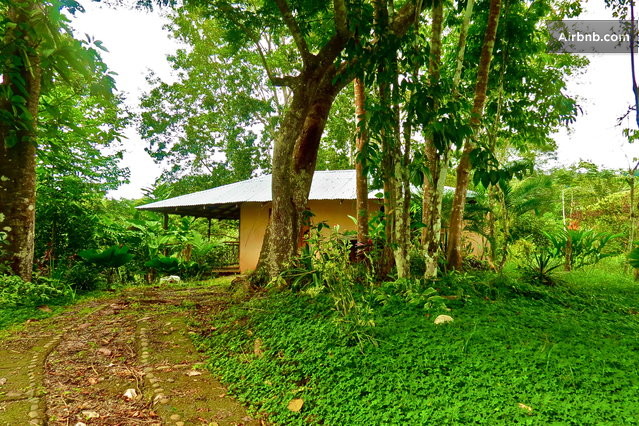
Today I’m flying to Costa Rica. There I’ll be staying in a “jungle house” by myself for 25 days. It’s rainy season, so I got a great deal (part of why I can afford this), and I’m sure the rain will help keep me focused on my goal of meditating on God’s Word and praying. I’m excited to be in Central America because I can work on my Spanish and learn more about Latin culture and Hispanic people.
I suppose “sabbatical” is a fitting term because this is a rest from work, a break to refresh and renew. I’m excited to refresh my faith by feeding it with essential nutrients. Too often in the city I’ve starved my faith by not being diligent in the core spiritual disciplines. Beauty makes me come alive, and I’m thrilled to immerse myself in such naturally beautiful places and let my soul spring out in worship to God. The house is in hike-able distance from some waterfalls and only about 6 miles from the Pacific coast, so I can even hike to the beach while memorizing scripture. 😄
Part II of my time in Central America will begin as I take a bus ride up to Lake Atitlan in Guatemala. There I’ll begin a more communal approach to the spiritual retreat, staying at a Catholic mission for almost three weeks, eating 3 meals a day with other volunteers and occasionally partnering with work of the mission. I’ll be able to choose my own pace, so some days I can help with their education projects, go to the coffee plantations, or even help out with mass in other villages, and other days I can just go to the chapel to pray or take a hike overlooking the “most beautiful lake in the world.”
I don’t want to merely do a lot of things in life; I want to become a man of God and to be fully devoted to the gospel. I believe the distinctive of Christian ministry is our use of God’s Word and prayer to a God who hears us and whose Spirit dwells within us. This summer I don’t want to be a tourist or go on another mission trip; I want to be with God. I’m grateful and humbled and excited and afraid as I step into this new journey—your prayers are much appreciated!
But reject those myths fit only for the godless and gullible, and train yourself for godliness. For “physical exercise has some value, but godliness is valuable in every way. It holds promise for the present life and for the life to come.” This saying is trustworthy and deserves full acceptance. In fact this is why we work hard and struggle, because we have set our hope on the living God, who is the Savior of all people, especially of believers.
Command and teach these things. Let no one look down on you because you are young, but set an example for the believers in your speech, conduct, love, faithfulness, and purity. Until I come, give attention to the public reading of scripture, to exhortation, to teaching. Do not neglect the spiritual gift you have, given to you and confirmed by prophetic words when the elders laid hands on you. Take pains with these things; be absorbed in them, so that everyone will see your progress. Be conscientious about how you live and what you teach. Persevere in this, because by doing so you will save both yourself and those who listen to you.