Tag: God

  • Did You Catch One?

    Did You Catch One?

    “Did you catch one?” asked 4 year old Cameron as I reeled in my lure from the front of my grandpa’s pontoon boat.

    “No, not yet. But I’ve already caught five keepers, Cam,” I replied.

    I’d caught 6 fish in less than an hour—and I was not the only one catching anything—yet still Cameron wanted to see more fish catching, more action, more entertainment.

    Children often ask for more. You give one a cookie and she immediately wants another one, before she’s finished chewing the first. You throw a kid in the air to hear him tickled with glee, and then the first thing he says is, “Do it again!” …and again, and again. I may have more discipline now when it comes to asking for cookies or patience in fishing, but I’m still guilty of a childish desire for the next thrill.

    Sitting with my back against our dwindling campfire later that night, I told my cousin, “I want to see another shooting star.” We had just seen a meteor zip across the sky and explode in the earth’s atmosphere, but I wanted to see another. My verbalized wish was almost immediately granted with a quick flash across the night sky. Then I caught my next thought: it was “More!”

    As adults we may have more years than children, but we often operate on the same principles—only with more tact. We’re better at covering up our selfish desires and more subtle about our need for thrills.

    Driving up to Nebraska this week I had 10 hours alone in the car to reflect on my summer in Central America. I rejoiced in all the beautiful moments and sights and relationships, but I also had the same, old doubts resurface. Where is this God I’m trying to follow? Why don’t I feel him? Here I’ve just had a refreshing summer full of examples of God’s faithfulness in my life, but still I ask where he is.

    The key is remembering.

    The Bible talks often of remembering what God has done for us. Old Testament rituals and celebrations emphasized re-living miraculous works of God. Yet the Israelites still forgot God as quickly as he blessed them. Communion/The Lord’s Supper is a sacrament to remember what Christ has done for us, yet we still turn back to sin. I have to keep choosing to turn to God and remember what he has done for me.

    The morning of fishing and stargazing, I read Psalm 23. The psalmist says the shepherd “makes me lie down in green pastures,” “leads me beside still waters” and “restores my soul.” Here I was sitting next to my Grandpa’s green lawn and the glossy, still lake with a peace of soul. The last time I read the chapter I was in a bus headed into San Salvador. I’d read “Even though I walk through the valley of the shadow of death, I will fear no evil for you are with me.” Little did I know I’d end up staying in a dangerous part of town that night, but I was kept safe. It’s important for me to continually remember what God has done in my life. With my child’s memory I quickly forget the small blessings and miracles in my life.

    We need habits of returning our minds to God’s wondrous works, and often the best way is reading the Bible. Lord, help us remember what you’ve done for us.

  • The Family of God: Who’s In?

    The Family of God: Who’s In?

    Adoption into the family of God is a beautiful thing, but how do we know who our relatives are? In my last blog post I wrote about finding Christian brothers and sisters during my time in Costa Rica. These heart-encouraging friends came as a refreshing contrast to those who didn’t believe as I do. But while these friends definitely felt like fellow adopted brothers and sisters, other acquaintances seemed like distant cousins. How do I know if they’re even in the body of Christ? Are they just odd family members or are they posers? Since we’re all adopted, it’s hard to tell who is in the family and who’s not (if anyone’s excluded…).

    Staff of Urban India Ministries

    Now I need to say very clearly: I don’t claim to know who is in the family of God. I can’t know who’s in God’s family, because I’m not God; that’s why this post is difficult for me to write. Yet I do know what God has revealed to us about the adoption process and the signs for who’s in the fam.

    Who’s in?

    The Bible explains that through our sin and disobedience to God, humankind was separated from God. “God is light, and in him is no darkness at all,” says 1 John 1:5. God had to separate us from Himself once we took on the impurity of sin, and there is no way we can overcome the distance by ourselves. Because of our sin, the only possible result for a righteous God was punishment with death. “But because of his great love for us, God, who is rich in mercy, made us alive with Christ even while we were dead in transgressions—it is by grace you have been saved,” explains Ephesians 2:4-5, revealing the beautiful redemption we can receive through Jesus Christ who died for us. So how do we get adopted? “Through Jesus Christ,” says Ephesians, in accordance with God’s pleasure and will. God wants us to be his family, and we can be… if we accept the offer. Jesus already died in our place, but the Bible tells us we must also humbly turn from sin—having faith that being in God’s family is worth following Jesus. 1 John 1:9 explains that “if we confess our sins, God is faithful and just to forgive us our sins and to cleanse us from all unrighteousness.” The simple but monumental step is the good news offered to us called the Gospel. I write about it often, but only because I can tell no more important story.

    Okay, so I get it… I believe that Jesus died for my sins and rose from the dead. Now what? How do you know I’m , that’s the tough part. We’ve all known way too many “Christians” who don’t act any different than anyone else. Yet the Apostle James says that “faith by itself, if it does not have works, is dead.” We’re supposed to be able to tell Christians apart because they obey the word of God—loving others, denying themselves, living generously. Jesus said, 

    Let me give you a new command: Love one another. In the same way I loved you, you love one another. This is how everyone will recognize that you are my disciples—when they see the love you have for each other.

    Christians are supposed to be marked by love. Historically, we often have been—Christians stand up for human life even when it’s mangled, imperfect, old, deformed, or dangerous to do so. Christians give up comforts to serve the poor. Christians die for the message they believe.

    Addressing Christian Universalism

    Why are not all people in the family of God? Why isn’t everyone saved? These are some difficult questions I’ve come to wrestle with through interactions here in Guatemala. Christian Universalism holds that all people will ultimately be reconciled God without any eternal punishment for sin. The view is extremely appealing. Who wants to believe that people are going to hell? Doesn’t that make God seem unloving?

    The questions are weighty; answers are not easy. Exclusivism is quite distasteful. Last week I sat in a metal school building discussing these ideas with a friend. As distant sunlight trickled in through the door across dusty concrete floors, we both felt the burden of differing theologies/beliefs about God and salvation.Looking to the Bible for truth, I’ve been studying Romans—a book I feel intimidated by for its dense theology. Romans 8 says, “There is therefore now no condemnation for those who are in Christ Jesus.” For those who are in Christ Jesus. In Christ Jesus. Everyone? No, it doesn’t seem so. Saint Paul writes that “Anyone who does not have the Spirit of Christ does not belong to him.” Hmm. He isn’t condemning anyone; instead, he is making clear that there is no condemnation for those adopted into the family of God through Christ.Paul is rejoicing in the grace given to those of us who believe. I still must soberly ask, what about the others? Will they not be saved? Why not? In the next chapter of Romans, Paul writes:What shall we say then? Is there injustice on God’s part? By no means! For he says to Moses, “I will have mercy on whom I will have mercy, and I will have compassion on whom I have compassion.” So then it depends not on human will or exertion, but on God, who has mercy.God chooses who will receive mercy? It seems unfair to my human way of thinking. I wish Paul wrote more about those who are not in Christ Jesus. Doesn’t the Bible also say that God “is the Savior of all people,” and “love never fails”? These are tough questions, yet I have to humbly hear Paul’s caution: “Who are you, O man, to answer back to God?” I’m limited in my thinking by my humanity. I don’t understand the ways of God; but if His Word says some receive mercy and some don’t, I have to stop questioning at some point and believe. I know belief in condemnation is not popular. I know it’s not “tolerant” of other religions and beliefs. I think I’d rather believe all will ultimately be saved, but the idea doesn’t sit well with me.I feel that universalism sucks the power out of the Gospel. If all will ultimately be saved, what’s the point in belief? What’s the point in following God in this life? Why all the talk about faith and belief in the Bible? Why all the commands? Wouldn’t it be easier to say, “Enjoy life and the fact you’re all okay.”?If all will ultimately be saved, I’m wasting my life trying to tell others about what I believe. It’s that simple; the point of Christian Universalism is pivotal for me. If I’m wrong, which I very well could be, then I’m causing people unnecessary trouble by preaching this Gospel. If I’m wrong, then I’m giving my heart unnecessary burden by praying for “the unsaved.”  But if my beliefs are in line with truth, then I absolutely ought to tell anyone I can that salvation is available to them. I absolutely ought to be less “open-minded,” because one way will prove to be right in the end. I’ve put all my chips in trusting Jesus Christ.     

    So there it is. I’m a mere human, so I don’t entirely understand the work of God. I appeal to the Bible because I don’t have anything else to hold on to. I don’t have any experience of the afterlife or any view into heaven. What I do have is what I believe to be the Word of God given to us in a written form, and it’s truer than anything else I’ve ever read. God is God. I am not. Jesus tells us the mysteries of God are such that He has “hidden these things from the wise and understanding and revealed them to little children.” Ultimately I have to trust God as my Father and rest in gratitude for the grace I’ve been given.

  • Loving God Like I Don’t Love Surfing

    Loving God Like I Don’t Love Surfing

    Sitting on my board in the warm, clear Pacific waters off the coast of Costa Rica, I couldn’t help but smile at the privilege of being where I am. I love the beach (here, “la playa”), and I love getting out in the water fighting against some waves. It’s especially nice when you get to look back toward land and see tropical mountains covered in lush green—right up to the coconut palms lining the beach. You’d be tempted to call it paradise.

    On this day I had finally decided to use my entire day’s budgeted $10 to rent a surfboard. I really enjoyed surfing with friends in college, so I figured I couldn’t pass up the opportunity while I’m living near the beach of some of Costa Rica’s best surf, Dominical.

    I chose the 8’ board because I know I’m pretty novice, and definitely out of shape, then walked out to the beach with a new American friend. Paddling out, duck-diving through turbulent waves and swimming against the strong rip tides, I was quickly reminded how exhausting surfing is!

    But I persevered.

    “I’ve only got the board for a day, right? And all that lap-swimming I’ve been doing is for such a time as this!”

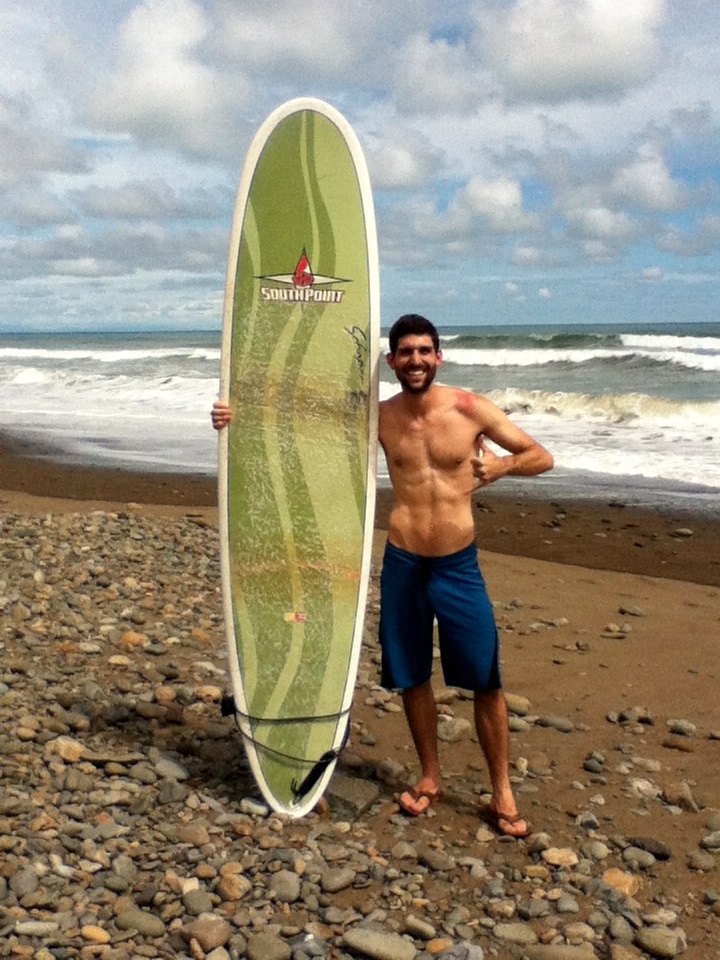
    Proving I can rent a surfboard in Costa Rica

    Wave after wave I’d watch go past me or go into me… I wasn’t really riding any of them.

    Contrary to common myth, surfing isn’t that much like snowboarding. There’s no lift to take you out to sea, and then your mountain either turns out to be a hill, or drops an avalanche on you to throw you swirling around in the salt water, trying to protect your head from getting hit by the board strapped to your leg.

    I’d been out in the ocean more than two hours (!), my arms were completely fatigued, my bare abdomen raw, and my hopes of catching a wave pretty low.

    Then there’s the social factor at play: you can feel all the other surfers are watching you and judging your skill. Pride reassures my mind with excuses: “I’m just out of shape.” “I’ve already been out here 2 hours.” “I haven’t surfed in more than two years.” “Can’t you tell I know which waves are good for me?” … but I’m still not riding any waves.

    Then I had a profound thought: I don’t really love surfing.

    Two-plus hours out in the ocean and I really hadn’t even been surfing. I’d been sitting on my board, watching waves, paddling around, enjoying the sun, sights and saltwater and watching other dudes surf. I was trying to surf, but was a frustrated failure.

    Then the other shocking realization: I often love God like I love surfing. I don’t.

    I like the challenge of the spiritual disciplines and the fulfillment they provide. I like the gifts God gives. I love the idea of grace, the commandment to love, and benefits of morality.

    I even love that my God is powerful, righteous, compassionate, creative, loving, fearful, just, relational, and good.

    But I often don’t love God Himself.

    Dr. John Coe (see previous post) writes,

    “the soul must learn to love God just for Himself in such a manner that He… is the center of all things.”

    Just as I would say I love surfing, even though I’ve spent numerous sessions without actually dropping in and riding a wave, I say I love God. Even when I’m not actually good at surfing, I appreciate the opportunities to experience beauty and to be in the ocean that surfing provides. Likewise, even when I don’t get a taste of God, I deceive myself into thinking I’m loving Him because I am surrounded by an encouraging Christian community or because the Bible spoke truth into my life.

    Though the analogy is admittedly weak, the idea helps me see the difference between loving God and loving all the things that surround Him while missing the essence.

    To bring the story a happy ending… yes, I did finally catch a wave. I spent over half an hour floating in the water next to my board, about done, and then the right wave happened to present itself. Suddenly, I was standing up on my board being propelled forward with all the hard-earned thrill that surfers dream of.

    (this is not me)

    I was truly surfing.

    I hope we all get the same experience of God. Keep pursuing Him. Keep reading the Bible and praying. Stay active in the local church and get discipled. It’s all worth it, because God is worth it. All the peripheral joys are great, but there’s nothing like actually experiencing God.

    Happy surfing!

    I have set the LORD always before me;

    because he is at my right hand, I shall not be shaken.

    Therefore my heart is glad, and my whole being rejoices;

    my flesh also dwells secure.

    You make known to me the path of life;

    in your presence there is fullness of joy;

    at your right hand are pleasures forevermore. 

    Psalm 16:8-9,11

  • Growing Pains

    Growing Pains

     God who is everywhere, never leaves us. Yet He seems sometimes to be present, sometimes absent. If we do not know Him well, we do not realize that He may be more present to us when He is absent than when He is present.

    –          Thomas Merton, No Man is an Island

    The last two weeks I’ve come to a painful realization of my lack of spiritual maturity.

    I don’t love God for being God.

    This is a tough thing to acknowledge for someone who has a lot of identity wrapped up in being a good Christian. I’ve done a lot of the right things to conform to the Christian culture; I’m even in Seminary, having dedicated my career to serving the Lord. People hope I’ll be successful as a Christian, including myself (whatever that means). But I’ve got a lot of growing to do.

    Coming to Costa Rica was my attempt to jump back from the cliff of doubt, despair and burnout in my faith, and to further prepare myself for ministry. Now that I’m here, I’ve found myself to not love spiritual disciplines. I find it hard to pray. Sometimes I have an aversion to God’s Word.

    Dark Night of the Soul

    The Dark Night of the Soul

    Many Christians are at least familiar with the term which comes from St. John of the Cross’s work, The Dark Night of the Soul, but we don’t really know how to recognize it or respond.

    For me, a night of the soul is a time that removes the guards I place between me and full devotion to God. I’ve got cushions—identities, securities, distractions—that keep me just safe enough from fully giving myself to God. Removing the padding is very uncomfortable.

    I’ve had my share of experiences which painfully kick out those crutches: being fired, leaving California, getting sick in India. These are times of great hardship, in part because I’m coming to the unappealing reality that I valued my job, my friends, or even my very life above the God who gave me life.

    Now I feel certain despair at my inability to create spiritual richness… to feel spiritual.

    Dr. John Coe, director of Biola’s Institute for Spiritual Formation, wrote an article that has resonated deeply with my experience. In it he writes,

    “Believers in a dark night… become aware of how little they really love God, how little joy they take in the spiritual disciplines. Yet they also perceive, with a kind of sadness, that the world and its pleasures cannot satisfy.”

    Yes, that’s it. I can try to read the Bible; I can try to pray. I can go on a hike with breathtaking views in places people call paradise. But none of it is satisfying if I’m not enjoying God.

    Coe goes on,

    “Though they certainly love God in the deep where the Spirit abides, they discover how little there is in their character that enjoys prayer and the Bible, how little they really love God characterlogically.”

    Exactly.

    The diagnosis is accurate, but what do I do?

    “Resist the temptation to spiritually fix oneself,”

    Coe advises, getting to a root problem of our spiritual pride. Instead of striving harder, I need to rest in God’s grace. This phrase is becoming a theme for my trip. Rest is a state of being, not doing. Humbly I must acknowledge my need for God and my absolute dependence on His grace.

    I’m learning to love God for who He is, even if it’s tough and shows me more of myself than I care to see.

    Growth is gradual; growth is tough. My Spanish is not suddenly fluent because I’m living in Costa Rica. I’m not suddenly more spiritual because I came here to study the Bible and pray. Out of my love for God I have to build a deep love for the Bible over a period of time, to build a habit of turning to God.

    “Be faithful to the spiritual disciplines,”

    Coe counsels those in the dark night,

    “despite the fact that practicing them may feel painful and lonely.”

    Because spiritual growth is a lifelong process, our faith requires diligent habits so that we can daily move forward while keeping Jesus Christ as our goal.

    If anyone would come after me, let him deny himself and take up his cross daily and follow me. For whoever would save his life will lose it, but whoever loses his life for my sake will save it. 
    – 
    Jesus